


Thirteen AI agents draft the notes, claim checks and reports your team types by hand. A person approves everything before it is saved. Built around the NDIS Commission’s de-identification position.
Watch the 2½ minute explainer · captions on screen
Loaded SCHADS rates over 48 working weeks, including super and on-costs. An estimate to start a conversation, not a quote. Your real figure comes from a two-week pilot on your own data. See every assumption ↓
No account managers, no offshore support desk. The people who scope it, build it and answer the phone are the same three.

Scopes every build and writes every quote. James is the one on the phone for your first twenty minutes and the one in your office in go-live week.

Designs the agents and the scrubber. Steve decides which model does which job, tunes the drafts to your team's language, and keeps the whole loop honest.

Runs onboarding, training and ongoing support. Heather is who your coordinators call when something needs adjusting, and who makes sure it gets done the same day.
Anywhere in Australia. Someone is in your office, at your desks, watching it run against your real records before a single agent is left switched on.
Not on sample data. We pull your actual files, run the de-identification, and you watch what leaves your building before anything is switched on.
They talk out a note, it comes back drafted, they fix what is wrong and save it. If the language does not sound like them, we change it there and then, not next month.
Claims, audit gaps, agreements. On their machines, on their logins, on a normal working day, so nobody is learning it from a PDF.
We leave when your team has used it and is happy with it, not when the install finishes. Travel is in the quote up front. No surprise invoice afterwards.
Twenty minutes on the phone, then a written scope: what you run, where the hours go, which of the thirteen is worth building first, and what it costs.
API keys issued, your templates read, the scrubber configured and tested on your real records before go-live.
The pilot. Your team uses them for a fortnight and you count the time before and after. That is the whole test.
You count the hours before and after and decide for yourself. If it worked, the rest go on in order of what hurts most.
A free 30 minute video call with James. No obligation, no sales script.
Prefer to talk? 0461 411 500 · hello@ozzieai.com.au
Want to look around first?
Try the live demo, no sign upJames will call you back, usually the same business day.
Every provider we speak to has the same three holes. None of them are a software problem. They are a "somebody has to sit down and type this" problem.
A support worker finishes a shift and writes the note from memory hours later. It is thin, it is not linked to a goal, and at plan review there is nothing in it that proves the funding was used the way the plan said.
Wrong item, no agreement cover, funds short, travel claimed without the kilometres to back it, the same shift billed twice. Every rejection is an admin hour you already paid for, spent again.
The gaps are known on the day the auditor asks, not four months before. Expired first aid, a policy that exists but was never applied, an incident report that missed the five day window.
Your care platform, your accounting and your documents stay exactly where they are. NDIS Wizard sits beside them in your own Australian cloud account, reads what it needs, and hands a person a finished draft to save.
No vendor owns this box
Drafts, never decides. API tier, not used for training. It only ever sees codes and tokens, and it never logs in to anything.
[P-1042] attended with [W-07], 9am to 3pm. Community access, shopping and lunch out. Settled well.Your worker or coordinator reads the finished draft with real names already back in, fixes anything, and approves it. Once approved, it is relayed straight back into your system under their name.
Nothing is installed inside your care platform. Nothing writes back until a person approves it in the command centre. The whole system is one loop, pointed at thirteen different jobs.
ShiftCare, Astalty, Brevity, Lumary, Deputy, whatever you already run. Participants, plans, goals, rosters, progress notes, incidents, agreements, claiming.
Xero or MYOB. A claim is checked against what was actually paid, and nothing touches your books until a person approves it.
Policies, templates, staff files, signed agreements on OneDrive, SharePoint or Drive. The agents read your templates so drafts come back in your format.
A person logs in, uploads the payment request, submits the incident, lodges the evidence. No key is ever issued for these.
The always-on gateway that does the work on your side. Reads your systems on a schedule, or the moment something changes in them. Holds the API keys per system, in a vault. Writes back into your systems only once a person approves in the command centre. Logs every single run: agent, source, output, who approved it.
Reads the draft with the real names already back in it. Nothing to re-type. Saves it in your care platform, sends the invoice, uploads to the portal. All under their own login. Agents write back only after a person approves.
It drafts. It never decides and never logs in. You do not buy a seat, sign up for anything, or change how anyone works.
In your template, in your language, with the tokens swapped back to real names before anyone sees it. Ready to read, fix and save.
Every run logged: which agent, what it read, what it produced, who approved it and when. That log is the answer when an auditor asks how AI is used in your service.
We start with the one or two that hurt most in your operation, prove them on your own data, then add the rest as they come up. Turn any of them off and the work goes back to manual. Nothing breaks.
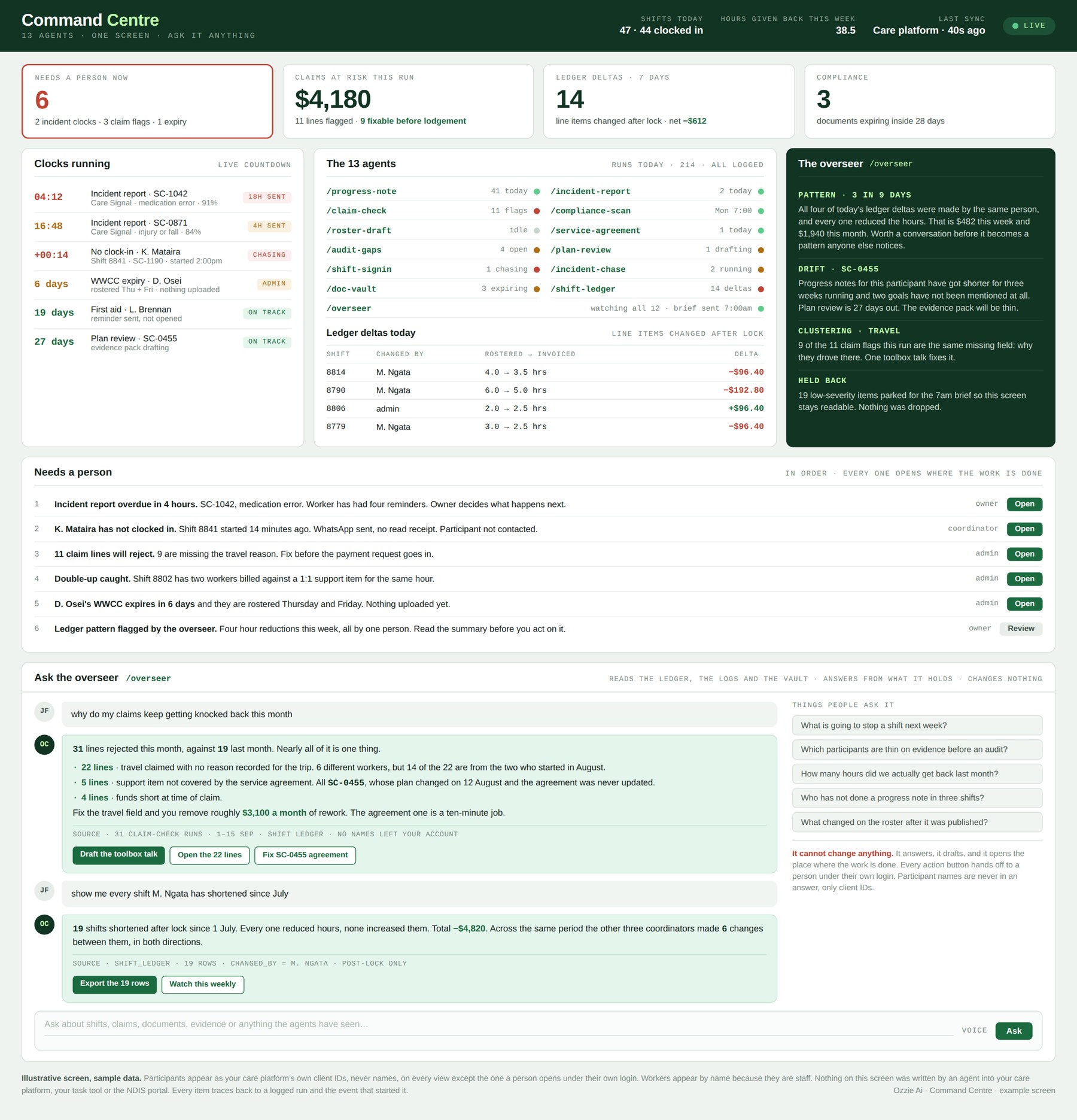
Built for your operation, not a template. Every agent, every clock, every flag and every dollar the ledger caught, in one place. Open it at 7am and you already know what today needs from you.
No. And this is the reason the whole thing is shaped the way it is, rather than being a chatbot someone pastes a case note into.
The scrubber runs inside your own cloud account, before a single character leaves it. What goes out is a shift record for client SC‑1042 against goal 3, not a record for a named person. The model has nothing to identify because it was never sent anything identifying.
The swap is reversible and the mapping lives only on your side. Tokens go out, the draft comes back, the real names go back in locally, the mapping is deleted. Your coordinator opens a finished draft with the right names already in it.
The Commission's guidance turns on information being "appropriately de-identified" and on "no personal information of participants disclosed to AI systems". Participant consent and an AI collection notice in your service agreement are the other half of it, and the /service-agreement agent puts them in. This is a design position, not legal advice, and you should have your own adviser look at it.
Every other tool we have looked at protects participant data by encrypting it, storing it in an Australian region, or asking staff not to type names in. The model still reads the name. Ours never receives it.
Before a single character leaves your account, the scrubber swaps every identifying detail for a token and every participant for your own client ID. The model drafts against tokens. When the draft comes back, the same scrubber swaps the real names back in, locally, and deletes the mapping. Nobody outside your building ever held the key.
Participants are referenced by your platform's own client ID from the first read. There is nothing to leak because the name was never fetched for the model.
DOB, address, phone, NDIS and Medicare numbers, family names in free text. Pattern and dictionary matching, tested on your real records in go-live week.
Each agent gets only the fields it needs for its one job. Nothing is pooled into a data lake. Nothing is kept past 90 days.
Your coordinator opens a finished draft with the right names already in it. The token map is deleted the moment it is used. Nobody re-types anything.
Not "encrypted in transit". Not "hosted in Sydney". Not a policy asking staff to be careful. Those protect the pipe. This removes the thing worth protecting before it enters the pipe.
The calculator is not a black box. This is every assumption inside it, so you can tell us which one is wrong for your operation and we will change it.
Hours are modelled, not promised. The figure that counts comes from the two-week pilot on your own data. Back to the calculator ↑
Most automation dies quietly: a platform update changes a field, a template gets edited, a key expires, and nobody notices until the work has drifted back to manual. Ongoing support exists to stop that.
Every run is logged, so a failed or late run is a signal, not a mystery. If an agent stops producing, we know before your coordinator does, and usually before the 7am brief.
ShiftCare, Astalty, Brevity, Lumary and Xero all ship updates. When a field moves or an API changes, we repair the connection. That is on us, not a new quote.
If drafts come back wrong in the same way twice, the agent is changed. New template, new goal wording, new coordinator with a different style: we adjust it, you do not work around it.
New staff, new participants, new name patterns. The de-identification rules are re-tested on your live records every quarter so nothing new slips through.
You call James, not a ticket queue. Same-day response in business hours, and an escalation line for anything that stops a shift or a claim run.
What each agent ran, what it drafted, what a person approved, and the hours it gave back. The same measure as the pilot, every month, so you always know it is still paying for itself.
An agent that is 95% right saves hours. An agent that quietly stopped three weeks ago costs you the hours and the trust. Once a team has been burnt by automation that faded, they go back to typing and never try again.
Support is included in the quote. It covers everything above, and it is the reason the number on the calculator holds in month nine, not just month one.
Taken from each company's public website. If something here is out of date, tell us and we will fix it.
If yours is not here, ask it on the call. Twenty minutes, no pitch.
No. The agents sit on top of ShiftCare, Astalty, Brevity, Lumary, Deputy or whatever you already run, through their APIs. The agents read and draft, and only write back into your software once a person approves it in the command centre. Nobody logs into anything new, and nothing is installed inside your platform.
They opt out and their records are excluded at the scrubber, before anything is read. The consent clause the /service-agreement agent adds to your agreements is where that choice is recorded, and it can be changed any time.
In your own Australian cloud account, which you own and can switch off. The runner, the scrubber, the keys and the logs all live there. What leaves it is de-identified text with client IDs and tokens, sent to an API-tier model that does not train on it. We never hold a copy of your records.
A person fixes it before it is saved, the same as they would with a draft from a new staff member. Nothing is saved, sent or lodged by an agent, so a wrong draft is a minute of editing, not an incident. Every run is logged, so if drafts are wrong in the same way twice, we change the agent.
As a log. Which agent ran, what it read, what it produced, who approved it and when. That, plus the consent clause and the collection notice, is the answer to "how is AI used in your service". The design follows the Commission's February 2026 position on de-identification, though you should have your own adviser look at it.
Every build is quoted to your business: a twelve-worker provider on ShiftCare and a two-hundred-worker provider on Lumary are different builds. The quote covers the agents you pick, the setup, travel for go-live week and the model usage. If it will not pay for itself at your size, we say so before quoting.
Two agents running on your real data inside two weeks of access being granted. You measure the hours before and after for a fortnight, then decide. Nothing else is built until you have.
Yes, any time. Revoke the API keys and the agents go quiet. The work goes back to manual, your platform is untouched, and you keep the system map, the logs and the write-up.
Two agents, running on your real records, measured on hours. Then you judge it.